
Bounce rate is basically the percentage of people who land on a website and then leave soon after without browsing further. So, it is a calculation of the number of single-page sessions, which is divided further by the total number of sessions on the website.
The bounce occurs when the user lands on your site, views only one page, and then takes a quick exit without interacting with any other elements of the website. Knowing about the importance of bounce rate is crucial for your business growth.
That’s why we have crafted a detailed blog post on bounce rate and its relevance for your website. So, let’s begin right away!
What Is The Bounce Rate?
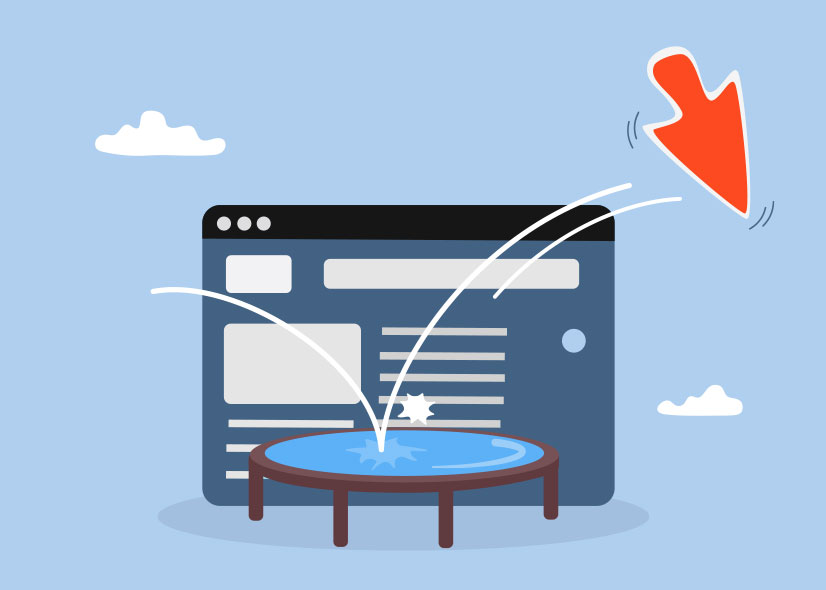
Bounce rate is the number of visitors who leave a particular website only after going through just one webpage, and that too partially. In this case, the visitors won’t take any further action, such as clicking on a link, filling the contact form, or even making a purchase. The bounce rate can be an indicator of the effectiveness of your website in engaging visitors.
Let’s say you own a business website or an online e-commerce store. So, the bounce rate in that case will be the measure of the number of times your potential customers walk in, look around, and leave without buying anything.
For the physical stores, this can be really bad for businesses. But, if you think about the online world, it can not only hurt the reputation of your website but can also affect the credibility of the search engines.
When the biggest search engine of them all, Google, notices a high bounce rate, its algorithms might assume that your content isn’t up to the mark or even helpful to the users. So, as a result, your website can be pushed a lot lower on the search engine results page(SERP), which can make it a lot harder for potential customers to find you.
How Can The Bounce Rate Be Calculated?
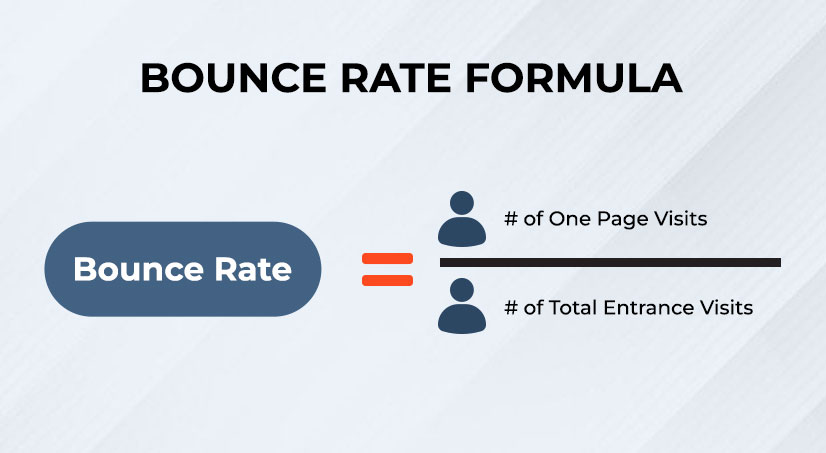
To calculate bounce rate, you should divide the total number of single-page sessions by the total number of sessions that happened on your site.
You need to understand that this calculation is quite simple, but the bounce rate might depend on the tool that you’ve used to measure it. For example, Google Analytics(GA4) follows a much more detailed approach when it comes to looking at different variables so as to measure engaged sessions.
A session can be considered as engaged if:-
- The visitor spends at least 10 seconds on a particular page of the website.
- The reader looks at least 2 pages.
- The user will trigger an important conversion event.
The Difference Between Bounce Rate And Exit Rate
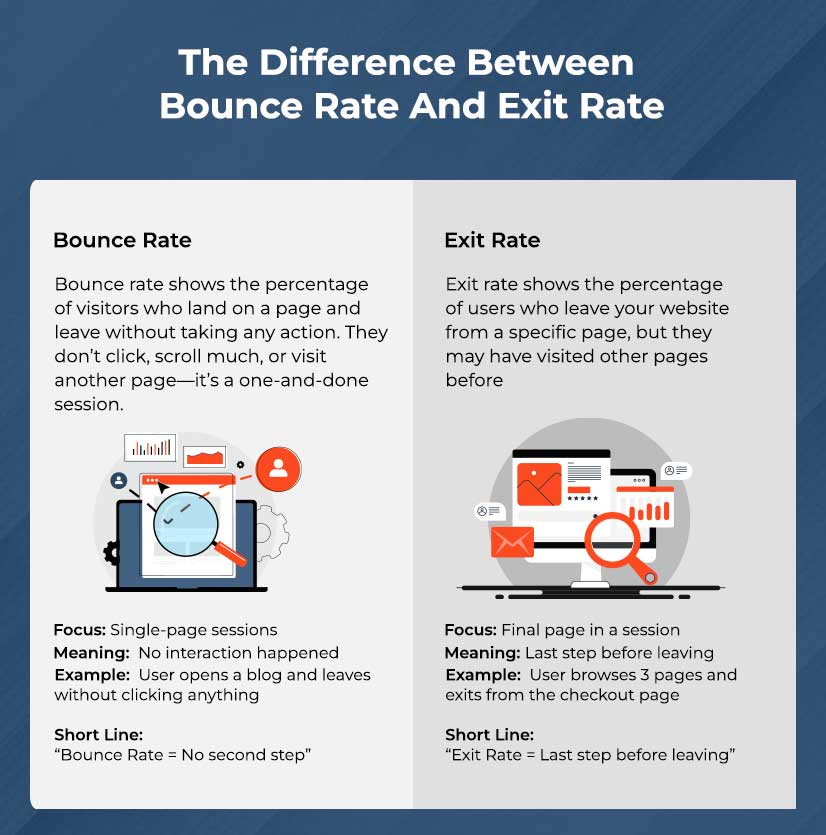
You must remember that bounce rate measures the percentage of visitors who move to another website after visiting only a single page of your site. In fact, they won’t even take any further action.
On the other hand, the exit rate will track how often visitors will leave the individual pages. It won’t look at whether they have seen other parts of your website or not.
You need to understand that these terms can look similar, but they are quite different. The difference is crucial as it will help you define the right bounce rate metrics for your site.
What Can Be The Average Bounce Rate For A Website?
The average bounce rate can be in the range of 25% to 70% but the average will be around 45%.
The bounce rate benchmarks can differ according to the industry. They can even vary as per the type of website you have. Another reason that your bounce rate can change will depend on the channel that gets users to your website.
As a matter of fact, the traffic that landed on your website through display ads bounces faster than that which came in through organic search. However, the users who had the least bounce rate came from referrals and emails.
How Can Bounce Rate Affect SEO?
Did you know that bounce rate is one of the most important Google ranking factors? In fact, websites that have a lower bounce rate will be much more likely to get a place on the first page of the SERP.
A website’s bounce rate will signal to search engines regarding the way in which users will interact with your site. When the bounce happens, the user will visit only one page and even leave soon after without buying anything. However, if the user engages with your website, this will show Google that your website is providing them exactly what they want.
Google focuses on the bounce rate and several other factors when assessing where your site truly belongs on the SERP. In case your site isn’t providing the true value that the users want, your high bounce rate is bound to affect your SERP rankings.
What Are The Reasons Behind High Bounce Rates?
Some of the probable reasons behind high bounce rates are as follows:-
- A website that loads slowly.
- Links and buttons that are unresponsive.
- Subpar UX and UI design of the website.
- Ads that can be intrusive.
- Content which isn’t relevant to the target audience.
- Not having the right type of website leads to a high bounce rate.
How Can You Improve The Bounce Rate Of Your Website?
Here are all of the approaches that you can follow to improve your site’s bounce rate:-
- Double down on the proven lazy loading approach by enabling it.
- Migrate your website to a private host.
- Carry out back-end optimization of your website.
- Utilize video content appropriately for your site.
- Boost the loading speed of your website.
- Craft the right type of H1 headlines and even content.
- Try to improve the reading experience through user-centric content.
- Write the content according to the search intent of the query.
- Have a contemporary and clean design for your website.
- Utilize the right type of internal links.
- Carry out robust mobile optimization for your site.
- Provide the exact thing that your website users really want.
- Get regular feedback and make tweaks in accordance.
Conclusion
A website that loads slowly and has irrelevant content will have a negative impression on the visitors and will even impact your website sales. In fact, when your website’s loading speed is not up to the mark, the bounce rate is bound to climb, and your website will be nowhere to be seen on the SERP.
Furthermore, you will face a similar situation when your site doesn’t have the right type of content. In both these cases, a lot fewer potential customers will find your site, and even fewer will be willing to stick around for engagement.
So, you need to fix all of these things if you’re serious about reducing the bounce rate and growing your business. SEO Toronto Experts can help you do the same. We have specialists in our team who know how to minimize the bounce rate by leveraging their SEO expertise. We have helped many clients in the past, and we can do the same for you. Get in touch with us now, and let’s discuss your requirements today.



